
Anti-Age(ism)
Figuring out what seniors never talk about and placing it centre stage.

In the Spring, I was gifted a ticket to a weekday matinee performance of a very special show. As an infrequent, yet appreciative patron of the theatrical arts, I’m always game for a Tuesday afternoon showing of anything - bonus points for any cultural excursion that has an interesting backstory.
The drive to Coquitlam’s [i] Evergreen Cultural Centre was uneventful until I reached the parking lot, which was, surprisingly, chock-a-block – not an empty spot to be found. People and cars were coming in from all directions. I ended up parking on the street, a half block away from the venue. Remember, this was a random Tuesday afternoon. Sure, it was April Fool’s Day, but this event was no joke.
I was now even more curious about the performance to come.
Following the signs to the front entrance and inching my way past volunteer greeters into the lobby, I spotted a sharply dressed Daisy Au, who welcomed me with a bright smile and an energetic: “Debbie! You made it!” Daisy and I have crossed paths for almost 10 years. This was our first time seeing each other in person.
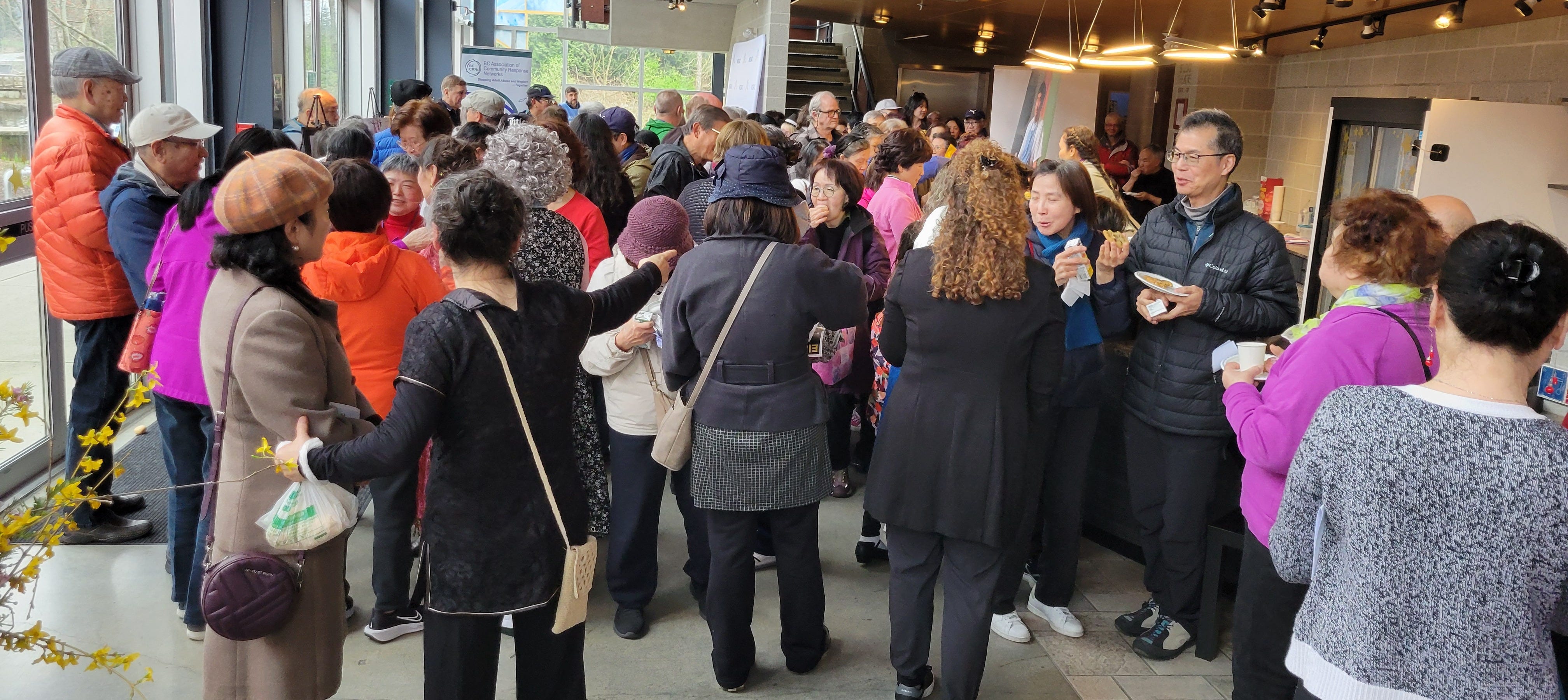
She whisked me past registration and information tables, introducing me to more volunteers and filling me in on what to expect. “We have about 200 people today,” she said, trying hard not to shout. The lobby was packed. “There are a lot of students from the local high school. We also received some feedback: some audience members had difficulty understanding the actors’ accents, so we are captioning all the dialogue and the songs for the first time today, too.”
Wow, I thought to myself.
I followed the crowd into the theatre with my programs, one in English and another in Chinese (to show my parents later), found an excellent seat, and settled in to watch the second of a four-show run of Seniors Take on Things We Never Talk About.
You could feel people’s excitement as the room filled. I was excited for everyone, too.
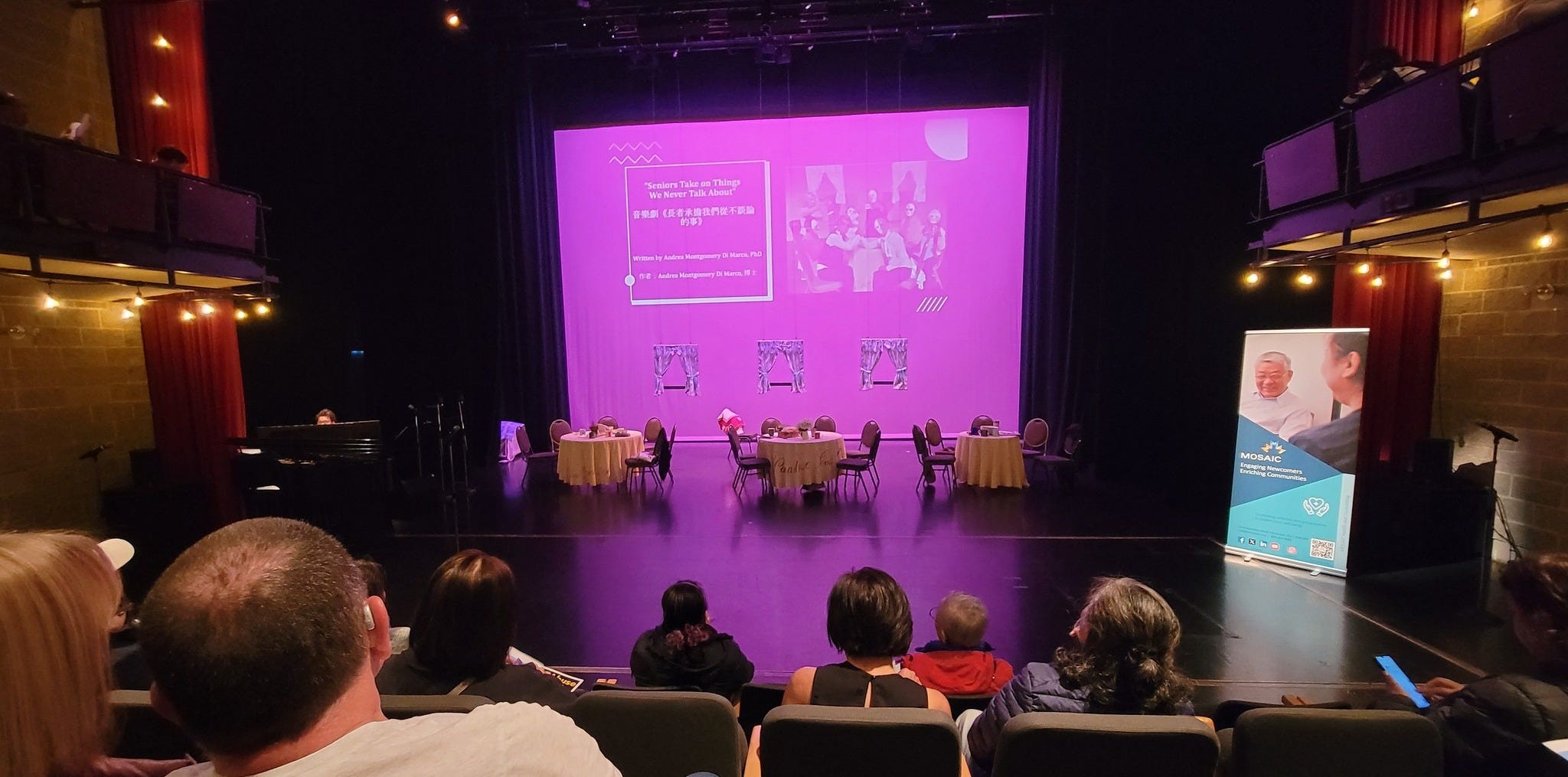
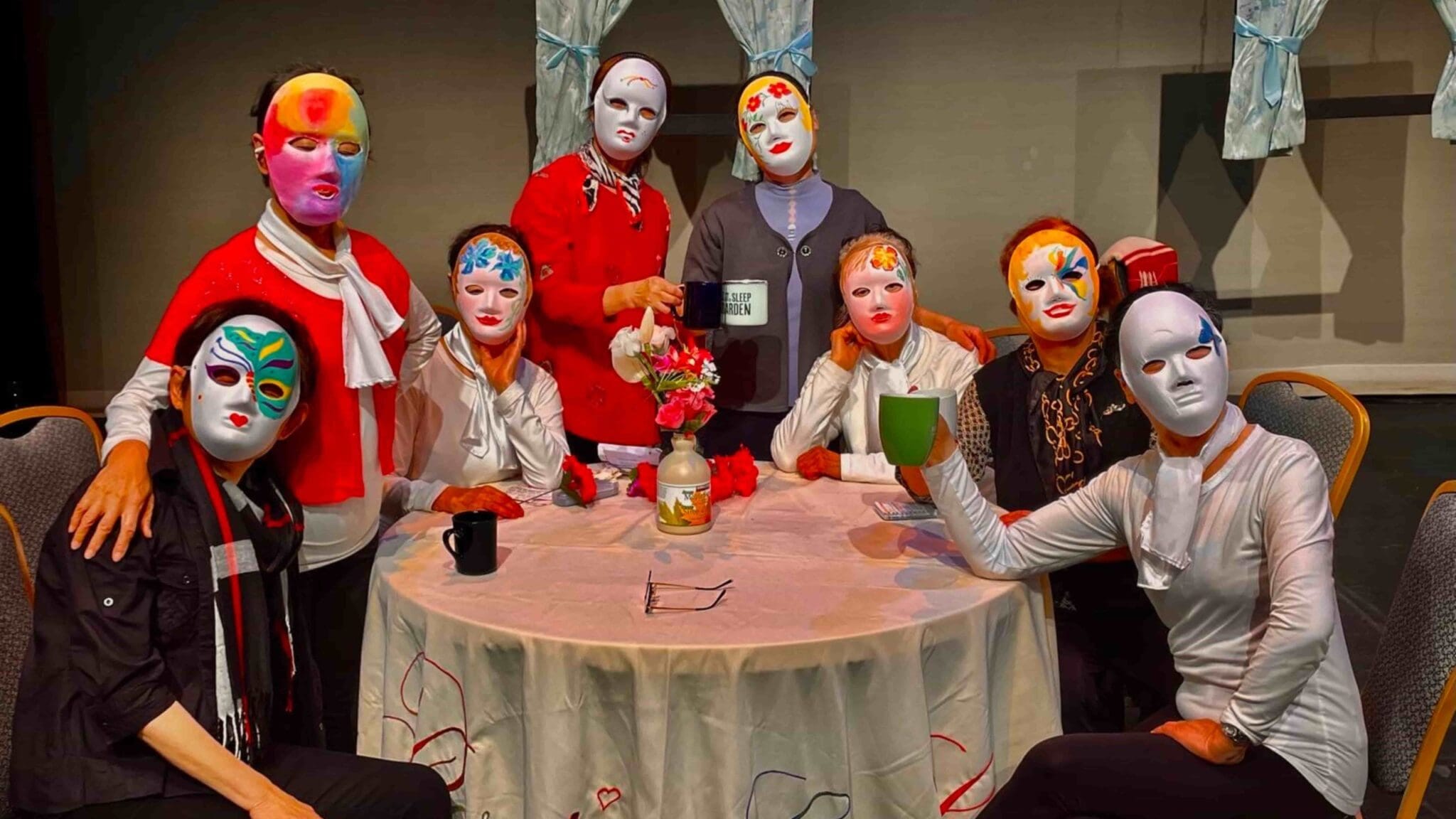
Seniors Take on Things We Never Talk About is an original musical theatre piece written, produced, and performed by volunteers and seniors of Vancouver’s M.O.S.A.I.C. Multi-lingual Orientation Service Association for Immigrant Communities, or MOSAIC for short. It’s one of the country’s largest settlement and employment services organizations. The production is the collective brainchild of longtime MOSAIC volunteer Andrea Montgomery di Marco, an award-winning[ii] educator, human rights activist, composer, and musician in White Rock, BC, and Daisy, MOSAIC’s Seniors’ Club Coordinator, who also happens to have decades of experience as a settlement counsellor.
The musical is a sequence of vignettes, offering the audience glimpses into the lives and private conversations of the residents, all immigrant seniors, of Paradise Seniors Lodge over two average days. There are secrets of abuse, loneliness, and regret; yearnings of love and connection; and impassioned pleas to be seen as more than “just old”.
“The data and the studies, I feel, only show us one perspective,” says Andrea. “If we just focused purely on the statistics, everything under the umbrella of ‘aging’ is problematized, which perpetuates limiting narratives and debilitating stereotypes.”
She’s right. Have a look at these stats I found in my research for this story:
Immigrants make up 28.4% of the general senior population (65+), and this number is growing.
Immigrant seniors, due to language barriers, racism and discrimination, ageism, and cut ties from family, friends, and culture make them easy targets for abuse and exploitation, contributing to negative health factors such as poverty, social isolation, and low access to health supports and services.
Many immigrant seniors also work past retirement age, often out of necessity. [iii] [iv] [v] [vi]
“Art and music allow us to gently explore the human side of social issues,” she explains. “Creative expression provides opportunities for artists and audiences to share in a tangible, multi-faceted experience no study can convey.”
“Sooner or later, we all age,” Daisy adds. “Ageism is experienced by everyone. I’ve watched how artistic expression can meaningfully transform this common human experience.”
The musical’s origins began in April 2018 with a choir, an idea shared by a client of Daisy’s named Celia, who wanted to learn English by singing songs. The choir’s first public appearance took place two months later in Burnaby’s[vii] Central Park as part of an open-air event to recognize World Elder Abuse Awareness Day (WEAAD).
“A handful of the choir members were musicians or former singers, but most had never sung publicly or in a choir,” says Andrea. (She is also the choir’s director and accompanist.) “During COVID, we shifted to online practice and learned that choir rehearsal on Zoom is awful…and hysterical.”
In 2022, members of the Seniors’ Club and the Chinese Community Response Network [viii] wrote and produced a three-episode Chinese-language audio drama series, re-imagining the art form to raise awareness of adult abuse and isolation. (Radio or audio dramas have long been a popular storytelling format in Chinese-speaking communities. [ix]) The series refreshed interpretations of beloved Chinese proverbs, opening up space for reflection and dialogue on aging with dignity.
Not Airing Dirty Laundry in Public (in Mandarin and Cantonese), Doing According to One’s Ability (also in Mandarin and Cantonese), and Community Breaking Isolation were released to the public on YouTube to recognize WEAAD on June 15 that year.
“That production resonated in the community,” Daisy shares. “Lots of them (seniors) started talking more openly about the abuse they or someone they know had experienced.”
In subsequent grant applications, Daisy wanted to focus MOSAIC’s programming on addressing adult abuse education and prevention. Having already worked with many of MOSAIC’s seniors as part of the choir, Andrea produced a smaller musical theatre piece, a test run, if you will, to gauge interest. Based on the enthusiastic response to the experiment, she designed an even larger theatrical production to educate and create awareness on one of the most sensitive and complex of social issues. Andrea floated the concept to the seniors, and they were ready for it.
She then met with MOSAIC seniors and older adults in the community through 2023, discussing the challenges facing immigrant seniors. The first script for Seniors Take on Things We Never Talk About was completed in July of that year. Andrea also wrote and scored half of the production’s 14 musical numbers as well as directed.
“There were many, many conversations over several years from multiple workshops discussing some tough stuff. Our subject matter experts were brave and transparent with sharing their experiences, the obstacles they had to overcome, and their beliefs,” she says.
The script was a compilation of research, both academic and participatory, and contains no direct quotes or direct references to what was shared during the workshops. It was imperative to Andrea that no one be further traumatized or exploited in the writing of the script.
An ensemble cast of 26, all volunteers and immigrant seniors, memorized dialogue, ran lines, rehearsed songs, and practiced choreography. Everyone involved put in the effort to understand the script. Everyone wanted the production to go well.
Seniors Take On Things We Never Talk About debuted on March 13, 2024, at Burnaby’s Michael J. Fox Theatre to an audience of 380 and positive reviews from loved ones and the community. [x]
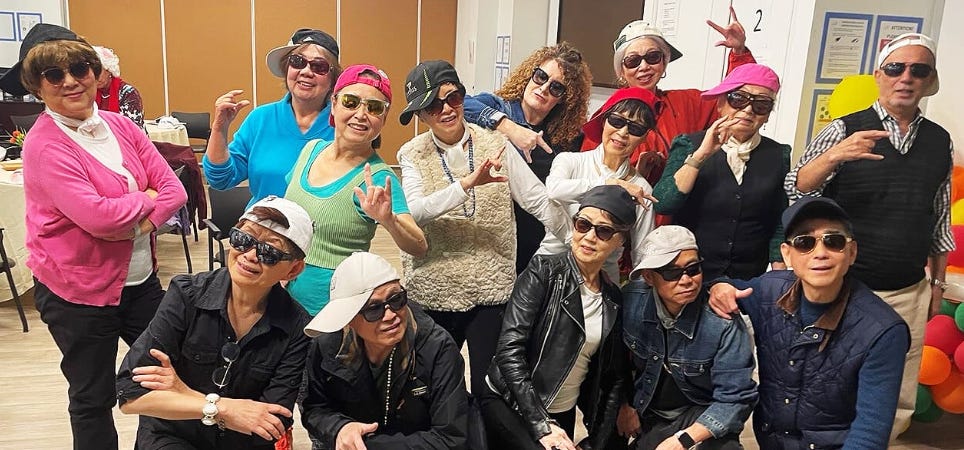
The response to Seniors Take On Things is unquestionable. A dozen more shows in Vancouver and Coquitlam followed, with the latest performances, including the show I went to, taking place just last April. These 12 performances translate to a reach of approximately 1,900+ people who were gifted, likely, their first anti-ageism experience.
“I’ve received so many stories of how people felt seeing their mother or father perform – so much pride,” Daisy shares. “These grown children, I believe, are gradually understanding their parents’ worth and what is possible. It’s an awakening.”
She and Andrea also observed the impact the musical had on its senior actors and stage crew.
“The musical allowed people to have agency. They had decisions to make for their performance. They had choices in how their characters spoke and moved, and what their characters’ back story involved,” says Andrea. “In working together, they bonded. They connected with audiences when they performed…it broke down isolation and created relationships with people other than their children, which is so important for immigrant seniors.”
“This is especially important for older immigrant senior women who grew up oppressed with no voice or choice. The musical was (and is) a platform where they can speak out for the first time,” Daisy adds. “The show is helping spread the message that they can reclaim their power. It is no coincidence that the cast is primarily made up of women.”[xi] [xii]
An unexpected and welcome injection of funding made it possible for the team to offer five more shows this summer, from August 6 to 8, where the original cast and crew will occupy the main stage of the Surrey Arts Centre[xiii]. To ensure there are no barriers to participation, tickets continue to be free of charge.
After August 8, however, the future of this quaint musical production is a bit of an unknown. It’s an everyday experience most community non-profits have where funding generally determines a program’s longevity.
“One third of our cast are over 80 years old, and health conditions can change anytime,” says Daisy. “I want to offer this opportunity to them as long as they are capable.”
If you are in a position to provide financial assistance and considering where to make a proven impact, allow me to plant a few seed thoughts with you. There are phenomenal ideas for the musical theatre group to:
Work with Metro Vancouver high schools and facilitate intergenerational learning in post-performance conversations.
Bring the show to care homes.
Partner with recreation directors and CEOs of assisted living campuses.
Instead of “taking care” of our seniors, what would happen if we shared accessible educational entertainment with them and the people around them instead?
How would the narrative on aging and ageism shift? How would attitudes change?
My thoughts on the show? (No spoilers.) It was impressive, thoughtful, and endearing. It takes guts to publicly share stories of some of the most painful experiences of life, never mind sing about them. I saw vulnerability, courage, empowerment, and camaraderie on that stage. I also saw my parents, family members, neighbours, colleagues, mentors, and friends in the characters portrayed.
Was there a standing ovation? You better believe it, and it was well deserved.
Daisy, Andrea, and I couldn’t connect after the show. The audience of 200 flowed out of the theatre into the lobby for celebratory snacks. I saw Daisy setting up what looked like a buffet of treats: there was enough for everyone. I spotted Andrea’s long, auburn hair and saw that she was in a focused discussion with a family. I caught a hint of one of the actors, then two, and then four more…all smiles.
Musical theatre as radical kindness. Bravo.
August 2025 Performance Schedule
Wednesday, August 6, 2025, from 6:30-8 PM
Thursday, August 7, 2025, from 2-3:30 PM and 6:30-8 PM
Friday, August 8, 2025, from 2-3:30 PM and 6:30-8 PM
Venue: Main Stage at Surrey Arts Centre, 13750 88 Ave, Surrey, BC, V3W 3L1.
Admission is FREE, but seats are limited! Please register online to secure your seat.
Resources
MOSAIC Linktr.ee: where you can find links to everything MOSAIC, including their socials.
Rediscovering Life: Fery’s Journey from Uncertainty to the Stage, MOSAIC, March 25, 2025.
Finding My Voice: Loretta’s Journey in the Seniors Musical, MOSAIC, March 10, 2025.
Contact
To contact Daisy or Andrea, email “Figuring It Out” through Substack, and I’ll connect you.
Sources and Notes
[i] Coquitlam is an urban city of over 174,000 people and is located 25-30 kilometers east of downtown Vancouver, BC.
[ii] https://mosaicbc.org/news/spotlight-andrea-montgomery-di-marco-human-rights-award/
[iii] Employment by choice and necessity among Canadian-born and immigrant seniors, Statistics Canada, April 2024.
[iv] Social isolation among immigrant and refugee seniors, Social isolation of seniors: A Focus on New Immigrant and Refugee Seniors in Canada, Employment and Social Development Canada, Federal/Provincial/Territorial Ministers Responsible for Seniors Forum, December 12, 2024.
[v] Aging and chronic diseases: A profile of Canadian seniors, Public Health Agency of Canada, 2020.
[vi] Immigrant Seniors in Canada: Working Beyond Retirement Age, ImmigCanada, May 25, 2024.
[vii] Burnaby is located 12-13 km east of downtown Vancouver, BC. With a population of over 240,000, it is also the geographic centre of Metro Vancouver.
[viii] MOSAIC is a member of the BC Association of Community Response Networks (BCCRN). The Chinese Community Response Network (C-CRN) is a committed team of Chinese-speaking volunteers who educate communities on adult abuse and neglect.
[ix] https://en.wikipedia.org/wiki/Radio_drama#Mainland_China
[x] https://mosaicbc.org/event/musical-theatre-free-ticket-burnaby/
[xi] https://mosaicbc.org/news/music-performances-in-metro-vancouver/
[xii] https://mosaicbc.org/news/immigrant-senior-stories/
[xiii] Surrey is the second-largest city in BC by population (nearly 700,000) and the largest by land area within Metro Vancouver (317.4 km² compared to Vancouver’s 115 km²).

Are you treating your parents any differently as a result of this?